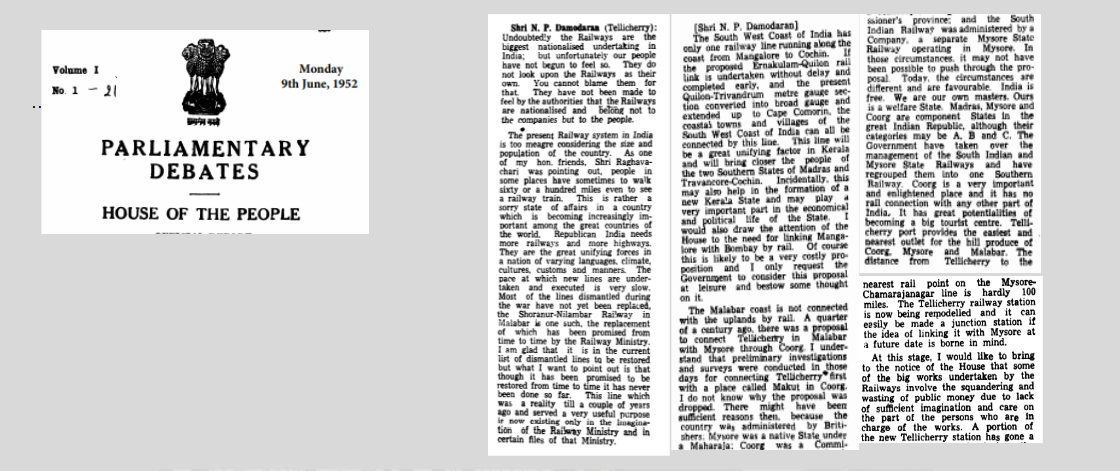
Full Version of the above speech
We are reproducing in the following pages, the full text of the above speech for the benefit of those interested in the history and politics of the country, and it shines a powerful light into to the personality and caliber of NetturP.
NetturP was a first time legislator, and the Parliament itself was new. He was also new to Delhi, and even though he was a firebrand freedom fighter who had to spend precious years of his youth in British jails, he had no background of the type of politics practiced in Delhi. He was comparatively young (39 years), and as a youth from a small town in Malabar, he was a stranger to the ways and processes of the national capital.
The Railway Minister was Lal Bahadur Shastri, whom he knew from pre-independence days, and for whom he had immense respect. All these factors never inhibited him from delivering a powerful speech, which commenced with a scathing attack on Railway authorities, and later on wastage of national resources by them. And as the reader will note, his approach was never narrow, and while guarding the just demands and requirements of his constituents, he was mainly speaking for the whole nation. The speech is notable on a number of counts:
- Fiery and strong worded and lengthy speech, full of facts and figures by a first time legislator, within less than a month of the first sitting of the Parliament.
- Demand for West Coast Railway (Konkan Railway) and Anooppur-Sengrowli and Sengrowli-Rewa lines raised for the very first time in Parliament, both of which later became realities. Raised demand for Thalassery-Mysore Railway for the first time, with full supporting facts and figures, which unfortunately did not materialise so far.
- Raised numerous other items, all of which became realities later.
Shri N.P.Damodaran (Tellicherry)
Undoubtedly the Railways are the biggest nationalised undertaking in India; but unfortunately our people have not begun to feel so. They do not look upon the Railways as their own. You cannot blame them for that. They have not been made to feel by the authorities that the Railways are nationalised and belong not to the companies but to the people.
The present Railway system in India is too meagre considering the size and population of the country. As one of my hon. friends, Shri.Raghavachari was pointing out, people in some places have sometimes to walk sixty or a hundred miles even to see a railway train. This is rather a sorry state of affairs in a country which is becoming increasingly important among the great countries of the world. Republican India needs more railways and more highways. They are the great unifying forces in a nation of varying languages, climate, cultures, customs and manners. The pace at which new lines are undertaken and executed is very slow. Most of the lines dismantled during the war have not yet been replaced, the Shoranur-Nilambar Railway in Malabar is one such the replacement of which has been promised from time to time by the Railway Minister. I am glad that it is in the current list of dismantled lines to be restored but what I want to point out is that though it has been promised to be restored from time to time it has never been done so far. This line which was a reality till a couple of years ago and served a very useful purpose is now existing only in the imagination of the Railway Minister and in certain files of that Ministry.
This can be seen in his very first speech in the Parliament, made on 9th June 1952, while speaking on the demands for grants for Railways. The cases marshalled by him for the South Western part of the nation commenced from Cochin – Quilon line, which was already on the anvil, and went on to the need to extend it up to Kanyakumari, keeping in view the uniform growth of the western area from Mangalore to Kanyakumari. Not stopping at that, he mooted the idea of laying a new line, connecting Mangalore with Bombay, drawing the Parliament’s attention to the blankness of this particular area in the Railway map of India. Thus, it was in fact he who initiated this great project, bringing up the need for a project serving the Konkan and linking two important cities on the west coast, Mangalore and Bombay, for the first time in Parliament , that too in his first speech.
The South West Coast of India has only one railway line running along the coast from Mangalore to Cochin. If the proposed Ernakulam-Quilon rail link is undertaken without delay and completed early, and the present Quilon-Trivandrum metre gauge section converted into broad gauge and extended up to Cape
Comorin, the coastal towns and villages of the South West Coast of India can all be connected by this line. This line will be a great unifying factor in Kerala and will bring closer the people of the two Southern States of madras and Travancore-Cochin. Incidentally, this may also help in the formation of a new Kerala State and may play a very important part in the economical and political life of the State. I would also draw the attention of the house to the need for linking Mangalore with Bombay by rail. Of course this is likely to be a very costly proposition and I only request the Government to consider this proposal at leisure and bestow some thought on it.
The Malabar coast is not connected with the uplands by rail. A quarter of a century ago, there was a proposal to connect Tellicherry in Malabar with Mysore through Coorg. I understand that preliminary investigations and surveys were conducted in those days for connecting Tellicherry first with a place called Makut in Coorg. I do not know why the proposal was dropped. There might have been sufficient reasons then, because the country was administered by Britishers ; Mysore was a native State under a Maharaja ; Coorg was a Commissioner’s province; and the South Indian Railway was administered by a Company, a separate Mysore State Railway operating in Mysore. In those circumstances it may not have been possible to push through the proposal. Today, the circumstances are different and are favourable. India is free. We are our own masters. Ours is a welfare State. Madras, Mysore and Coorg are component States in the great Indian Republic, although their categories may be A, B and C. The Government have taken over the management of the South Indian and Mysore State Railways and have regrouped them into one Southern Railway. Coorg is a very important and enlightened place and it has no rail connection with any other part of India. It has great potentialities of becoming a big tourist centre. Tellicherry port provides the easiest and nearest outlet for the hill produce of Coorg, Mysore and Malabar. The distance from Tellicherry to the nearest rail point on the Mysore-Chamarajanagar line is hardly 100 miles. The Tellicherry railway station is now being remodelled and it can easily be made a junction station if the idea of linking it with Mysore at a future date is borne in mind.
At this stage, I would like to bring to the notice of the House that some of the big works undertaken by the Railways involve the squandering and wasting of public money due to lack of sufficient imagination and care on the part of the persons who are in charge of the works. A portion of the new Tellicherrry station has gone a few inches underground during the process of remodelling. The place where the new station is being constructed is marshy and the authorities ought to have made allowance for these factors before they undertook the construction of a huge building of the present magnitude at the present site. I do not know whether the work which had been suspended when I left the place has since been resumed. Thousands of rupees have been sunk in the construction of a waiting shed at Jagannath Temple Gate Railway station near Tellicherry. Here the building collapsed before it was completed, and the result has been that the passengers have not only had no waiting shed but they are put to a lot of difficulties due to the existence of the remnants of the collapsed shed not having been removed. The same fate overtook a well dug at Cannanore. It has been abandoned after a poor labourer had been crushed to death inside the well by the falling off of the bricks when it was being constructed. Stringent measures should be adopted for preventing this kind of squandering and wastage.
I do not know whether there is provision for an overbridge at the Tellicherry station in the remodelling scheme. If provision has not been made, I would request the Railway Minister to provide an overbridge under the remodelling scheme, as it is an urgent necessity. Tellicherry town proper is on the western side and the station is on the eastern side of the railway line. I was speaking on the need for a Tellicherry-Mysore rail link when I was forced to make this digression.
I shall now refer to the main point and that is that there is considerable public feeling in favour of the proposal. A number of local bodies and popular organisations in Malabar have passed resolutions requesting the Government to undertake the construction of this new line.
The leading Malayalam Daily, Mathrubhoomi, has made an editorial appeal to the Government and to the Members of Parliament to move in the matter. I am sure the people of Coorg and Mysore are also in favour of this proposal. The proposed line will benefit them also equally. Even if in the previous regime the scheme may have been thought to be not sufficiently remunerative, I am certain that under the changed conditions of today the proposed line will be remunerative, as every place through which this line will pass has been thickly populated now and all the lands there are under cultivation. The laying of the new line will very greatly help the industrial and agricultural advancement of Malabar. Coorg and a portion of Mysore. I would request the Government to bestow their serious attention upon this proposal and re-open the question which had once been taken up and subsequently dropped. This line will also provide an alternative route from the west coast to the east coast across the peninsula through Mysore and Bangalore.
One of my hon. friends here has just now brought to my notice the need for the construction of new railway lines in Vindhya Pradesh. Vindhya Pradesh is the biggest State in India, and it looks curious that Vindhya Pradesh has got only a stretch of 100 miles of railway line. It has been suggested that two new lines may be laid, namely, one from Anooppur to Sengrowli and another from Sengrowli to Rewa. I request the Railway Minister to give this proposal their careful attention.
Before sitting down, I wish to refer to one or two local grievances. Badagara is an important town and big business centre in Malabar. It requires a big and spacious railway station. The existing one is very small and quite out of proportion to the size, importance and population of that town. I request that Badagara may be included in the southern Railway’s scheme for remodelling of stations in this year. Calicut railway stations also requires remodelling. It is impossible for passengers to move about on the platform. It is always full of parcels. I would therefore, request the provision of a parcels shed there. Also there is need for an overbridge on the northern side of the railway station. At present the traffic is very much held up at this place due to the level-crossing.
Payyoli and Vellayil are two important stations on the Southern Railway which lack proper station buildings. At present, instead of proper buildings, you have got dilapidated railway bogeys which are used for this purpose. They have been there for the last so many years. Many representations were made to the Government and to the railway authorities from time to time to construct buildings at these stations. I find that in the previous Parliament, cut motions had been moved by a Malabar Member to discuss this matter. When the then Minister of State for Railways, Shri Santhanam, visited Malabar, a deputation went to him and impressed upon him the need for constructing a building for the Payyoli station. I was told that the Minister agreed and gave his word that the station would have a big building before long. The leader of that deputation, an advocate of Payyoli, perhaps purposely and ironically asked the Minister whether he would be there to see the new building. The jovial and well meaning Minister gave a reply in the affirmative. But alas! before the Minister could fulfil his promise the leader of the deputation to whom he gave that promise breathed his last ; and on his own part the Minister went out of office to some other place from where he cannot do anything in the matter. This story was narrated to me by the deceased advocate’s son, who is also a practising advocate there. So, at least before another generation passes away and before another Minister goes out of office, I humbly pray that Payyoli may have a pucca station building.